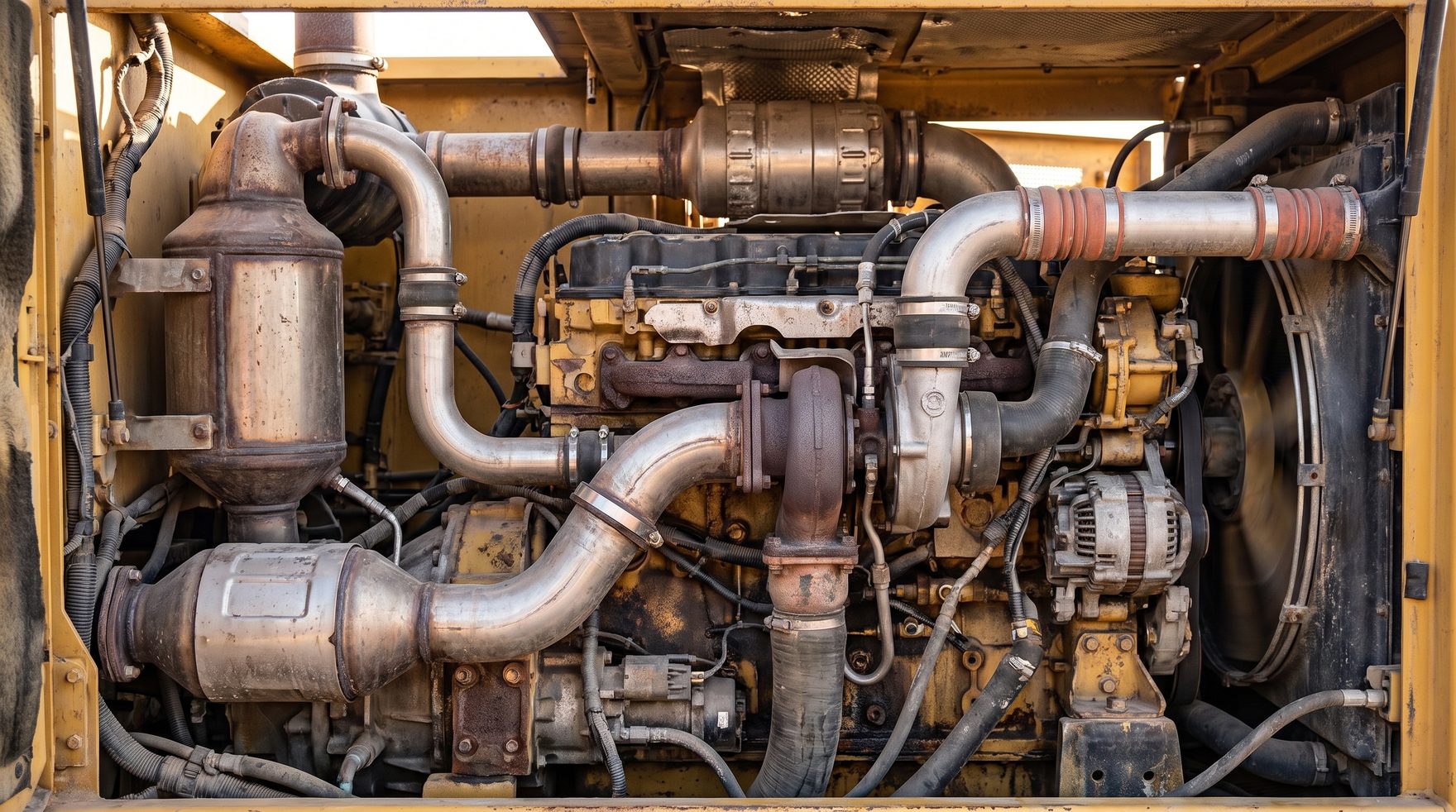
You hit the regen switch, you wait, the machine derates anyway or the light comes right back the next shift. Maybe it never even finishes, it just sits there thinking about it like it has somewhere better to be. Meanwhile you have got dirt to move, a rental clock running if this isn't even your machine, and a dealer service line that answers like they're doing you a favor. Every hour you keep running it in that condition is an hour closer to turning a filter problem into an engine problem. Here's what's actually going on under that DPF light and what it takes to make it stop coming back.
What Regen Is Supposed to Do
The diesel particulate filter traps soot out of the exhaust so it doesn't go straight into the air. Left alone, that soot builds up and chokes the engine's breathing, which is why the system periodically burns it off. That's regen.
There are a few flavors. Passive regen happens on its own when exhaust temps run high enough during normal work, like grading with a loaded machine for a couple hours. Active regen is the ECM stepping in to add extra fuel and heat when passive alone isn't cutting it. Forced regen is a technician manually commanding the process with a scan tool, usually parked and stationary. Parked regen is similar but operator initiated from the cab. All four are trying to do the same job, just under different conditions.
When any of those stages fails to complete or the light comes right back a few hours later, the machine is telling you the soot load never actually got burned off. Something is stopping the process.
Why It Won't Finish or Keeps Coming Back
Nine times out of ten it traces back to one of a handful of usual suspects. A code will point you in a direction but it won't hand you the actual cause, that part takes a scan tool, a temp gun, and someone who has chased this before.
A heavily clogged DPF. so much soot or ash has packed in that exhaust can't flow enough to reach regen temperature, no matter how long you let it try.
Short work cycles. if the machine is idling, doing light digging, or getting shut down every twenty minutes, exhaust temps never climb high enough long enough for passive or active regen to complete.
A failed exhaust temp or differential pressure sensor. if the ECM is reading bad data, it can think the filter is fine when it isn't, or abort a regen that was actually working.
A fuel or dosing problem. weak injector performance or a DEF dosing fault upstream can starve the regen of the heat and chemistry it needs to burn soot off cleanly.
What Happens If You Keep Ignoring It
The tempting move is to just keep hitting the regen button and go back to work, figuring it'll sort itself out eventually. Sometimes it does. More often you're just adding hours onto a filter that's already in trouble.
Push a plugged DPF too hard and the soot inside can cook into ash, a much harder deposit that'll not burn out in a regen no matter how many times you run one. At that point you aren't looking at a cleaning anymore, you're looking at a new filter, and those aren't the cheap kind.
"A regen light is the machine asking for five minutes. Ignore it long enough and it starts asking for a new filter instead."
What You Can Check Before You Call
Some of this you can rule out yourself in the yard without tools, before paying anyone to come look at it.
- Duty cycle honesty. has the machine mostly been doing light, stop and go work lately, or sitting and idling more than running under load?
- Regen light behavior. does it come on steady or blinking, and does it clear at all before returning, or does it never clear?
- Any recent codes. check the display or gauge cluster for related fault codes tied to exhaust temp, DEF, or filter differential pressure.
- Fuel and DEF levels. low DEF or contaminated fuel can trigger dosing issues that stall the whole regen process before it starts.
How We Fix It On-Site
We come out, hook up a scan tool, and pull the actual data instead of guessing off a dash light. That tells us whether the filter itself is loaded, a sensor is lying, or the fuel and dosing side is the real problem.
From there we run a forced or parked regen under controlled conditions to get soot burned off properly, then go after whatever caused it to fail in the first place, whether that's a sensor swap, a dosing repair, or addressing the duty cycle issue. We repair the emissions system so it works the way it was designed to. We don't delete or tamper with it. Deleting a DPF is against federal law, it'll fail inspection down the line, and it just trades one problem for a bigger one later. Fixing it right the first time is cheaper than explaining a delete to whoever buys the machine next.
Questions
DPF regen, quick answers
How long should a forced regen take?
A forced or parked regen typically takes 30 to 60 minutes depending on how loaded the filter is. If it repeatedly stalls out or fails to complete, the DPF, a sensor, or the fuel and dosing system likely need attention beyond just running another regen.
Can I just keep running the machine to force a passive regen?
Sometimes light, steady load work will let passive regen finish on its own. But if the filter is heavily clogged or a sensor is faulty, continuing to run it hard can cook the soot into ash that can't be burned out, requiring filter replacement instead of a cleaning.
Is deleting the DPF a faster fix than repairing it?
No. Deleting or tampering with a DPF is illegal under federal emissions law and it doesn't fix the underlying cause. It also creates inspection and resale problems down the line. The correct fix is diagnosing and repairing the actual issue.
Written by
Tyler Reed, Reed's Mobile Services
Tyler is a mobile heavy equipment mechanic and welder based in Middleburg, Florida, with 12 years turning wrenches on excavators, loaders, dozers, and tractors. He fixes machines where they sit, across North Florida and South Georgia. Got one down? Call or text (352) 507-3088.