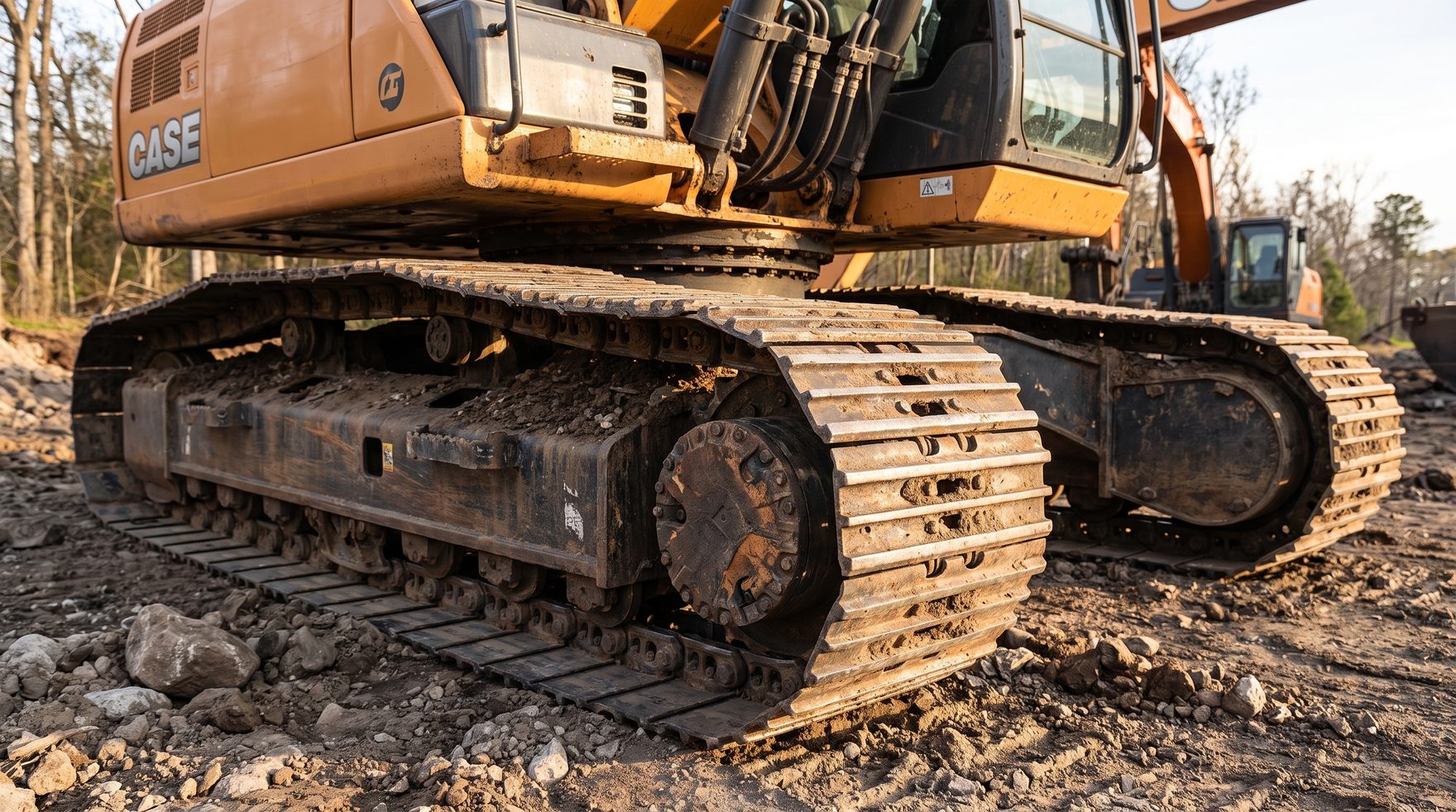
You point the machine dead straight and it wanders off to one side like it's had a couple beers. Or one track just flat refuses to keep up with the other. It's easy to shrug off for a few days, tell yourself you'll deal with it later, and honestly I get it, you've got a job to finish. But a final drive that's starting to go is on a clock, and what you do in that first week usually decides whether this is a seal-and-gear-oil afternoon or a brand-new drive motor and a very quiet ride home.
What the final drive does
Each track has its own final drive: a hydraulic travel motor bolted to a set of planetary gears that turns that motor's speed into the torque that moves the machine. There's one on each side, running in its own bath of gear oil. When one side wears out or loses its oil, that track slows down, gets noisy, or quits, while the other side keeps working fine, which is exactly why the machine crabs to one side.
The warning signs
Drifts or crabs to one side when you're trying to travel straight.
One track noticeably slower or weaker than the other, especially on a grade.
A whine, grind, or clunk from one track motor as it turns.
Gear oil low, or metal shavings in it when you pull the check plug.
Oil weeping from the final drive or the hub, which means the seal is letting go.
What usually causes it
Worn planetary gears, often because a leaking seal let the gear oil run low and the gears ran dry.
A failing hydraulic travel motor that's bypassing internally and won't make full torque.
A dragging brake pack inside the drive that won't fully release.
Low or contaminated gear oil, where a small leak quietly starves the drive until it comes apart.
Sometimes it isn't the drive at all, it's a hydraulic problem feeding it, a control valve or a travel motor issue. That's worth knowing before you drop serious money on a final drive you might not even need, because a proper check tells the difference.
Check the gear oil, it's the cheapest tell
Before anything else, pull the check plug on the slow side's final drive and actually look at the oil. Is it low? Is there metal on the plug or glitter in the oil? Is it milky, like coffee with too much creamer, from water getting in? Each of those tells a story, and none of the stories end with "it's fine." Low or metal-laced oil means the drive is already eating itself, and topping it off buys a little time but fixes nothing. Catching it here, while it's still just a seal and a jug of fresh oil, costs a fraction of what comes next.
"A whining final drive still moves the machine, which is exactly the trap. It lets you keep pretending it's fine."
Why you shouldn't keep running it
This is the part that costs owners the most money, so listen up. A final drive that's whining or low on oil still moves the machine, which is exactly the trap, it lets you keep pretending it's fine. But every hour running on dry or metal-filled gears grinds them down further. What could have been a seal and a gear-oil service quietly becomes a full planetary rebuild, or a whole new final drive, once the gears and the motor chew each other up. Catch a leak or a whine? The cheapest thing you'll ever do for that machine is shut it down and get eyes on it while the damage is still small and boring.
Questions
Final drives, quick answers
Why does my excavator drift to one side?
Because one final drive isn't keeping up with the other. A worn planetary set, a failing travel motor, a dragging brake, or low gear oil on one side slows that track, so the machine crabs toward the slow side when you try to travel straight.
Is metal in the final drive gear oil bad?
Yes. Metal on the check plug or glitter in the oil means the gears or bearings are wearing. Topping off the oil buys a little time but doesn't stop the damage. It's a sign to stop running it and get it checked before it turns into a full replacement.
Can you rebuild or replace a final drive on-site?
In most cases, yes. We come to the machine, check the gear oil, and determine whether it's a seal-and-planetary repair or a travel-motor issue, then handle the repair on your jobsite so the machine doesn't have to be hauled off.
Written by
Tyler Reed, Reed's Mobile Services
Tyler is a mobile heavy equipment mechanic and welder based in Middleburg, Florida, with 12 years turning wrenches on excavators, loaders, dozers, and tractors. He fixes machines where they sit, across North Florida and South Georgia. Got one down? Call or text (352) 507-3088.