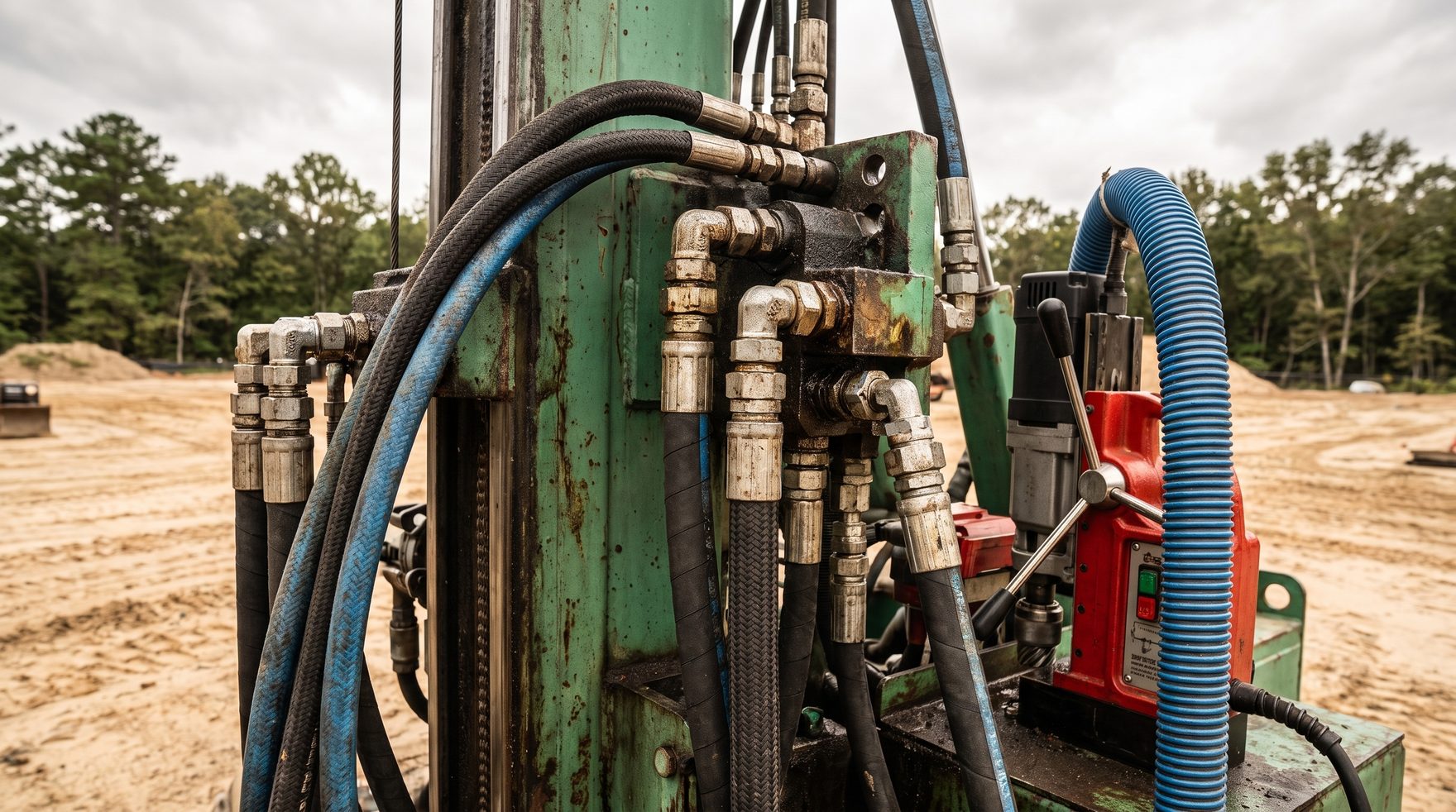
You're mid-cycle, boom's out, and all of a sudden there's a puddle where your hydraulic pressure used to be. That's a blown hose, and it doesn't care that you had three more loads to move before lunch. One second the machine's working, the next it's a lawn ornament sitting in its own oil. Now you're staring at a dealer parts counter that wants your model number, your hose length in inches, and about five business days you don't have. You can fix this today, not next week. The trick isn't just slapping a new hose on and calling it done. You've got to figure out why it blew in the first place, or you'll be doing this exact same dance again before the month's out.
First, what a blown hose actually costs you
It's not just the hose. It's the oil dumped on the ground, the machine sitting idle, and every hour you're not moving material is an hour you're paying for equipment that isn't earning. Guys try to nurse a weeping hose along for a day or two, telling themselves they'll deal with it Friday. Then Friday it lets go completely, usually somewhere less convenient than where it started leaking.
A full blowout can empty a reservoir in under a minute depending on where it lets go. That's not just a mess, that's a pump that can run dry and cook itself if the machine keeps cycling. So the second you see oil where it shouldn't be, shut it down. Don't try to finish the pass.
Why hoses blow in the first place
Hoses don't usually just fail out of nowhere. Something set it up. Florida doesn't help either. Heat and UV break down the rubber cover faster than it does up north, so a hose that'd last years in a cooler climate is already brittle and cracking here after a couple of Florida summers.
The real fix isn't just a new hose. It's finding out what killed the old one so the replacement doesn't die the same way.
Rubbing on a rock guard or frame member vibration wears through the outer layer until it weeps, then splits.
Wrong length or bad routing too tight through a turn stresses the hose every time the boom moves.
Sun-baked and brittle years of Florida heat and UV exposure dry out the rubber even if it looks fine on the outside.
Running over-pressure a hose rated for the wrong PSI or a stuck relief valve pushes it past what it's built for.
Age and flex fatigue high-cycle hoses near the cylinder take the most bending and wear out first.
What you can safely check before we roll out
You don't need to be a hydraulics guy to spot the obvious stuff. A quick look while you wait for us can tell you a lot, and it helps us bring the right fittings the first time.
- Find the exact spot it let go note if it's at a fitting, mid-hose, or right where it crosses a frame edge.
- Check for rub marks nearby look at hoses running next to it for wear that hasn't failed yet, they're usually next.
- Note the reservoir level if it's way down, don't start the machine again until it's topped off and bled properly.
- Snap a photo of the routing how the hose runs from fitting to fitting helps us match length and bend radius fast.
How we fix it on-site
We don't show up guessing. We build the replacement hose right there in the truck to your machine's actual length, fitting type, and pressure rating, so it's not a stretch-and-hope job or a hose that's rated for something lighter than what your machine actually pushes.
Then we clean up the oil that dumped out, refill the reservoir, and bleed the system so there's no air trapped in the lines. Air in a hydraulic circuit gives you spongy, unpredictable movement, and that's not something you want on a machine with a bucket or boom near people.
And before we button it up, we look at why that hose failed. If it was rubbing, we reroute it or add protection. If it was over-pressured, that's a different conversation, one about the relief valve or the circuit, not just the hose.
"A new hose that fails the same way in three weeks isn't a fix. It's a delay."
When it's more than just the one hose
Sometimes a blown hose is the symptom of something bigger going on in the hydraulic system, not a standalone fluke. If you're also seeing the machine feel weak or slow under load even after the new hose is on, that points to something further upstream in the circuit.
If that's the case, worth reading up on why hydraulics run weak and slow under load, because chasing one hose while ignoring a pump or valve issue just gets you back here again.
Questions
Hose blowout, quick answers
Can I just wrap a blown hydraulic hose to keep working?
No. A wrapped or clamped hose can fail completely under pressure and spray hot oil. Shut the machine down and get the hose replaced properly instead of running on a temporary patch.
How fast can a mobile mechanic replace a blown hydraulic hose?
Most single-hose replacements can be done on-site the same day, since we crimp hoses to length and fitting on the truck rather than ordering a pre-made part from a dealer.
Why do hydraulic hoses fail more often in Florida?
Heat and UV exposure break down the rubber cover faster than in cooler climates, which shortens hose life and makes cracking and dry rot more common even on lower-hour machines.
Written by
Tyler Reed, Reed's Mobile Services
Tyler is a mobile heavy equipment mechanic and welder based in Middleburg, Florida, with 12 years turning wrenches on excavators, loaders, dozers, and tractors. He fixes machines where they sit, across North Florida and South Georgia. Got one down? Call or text (352) 507-3088.