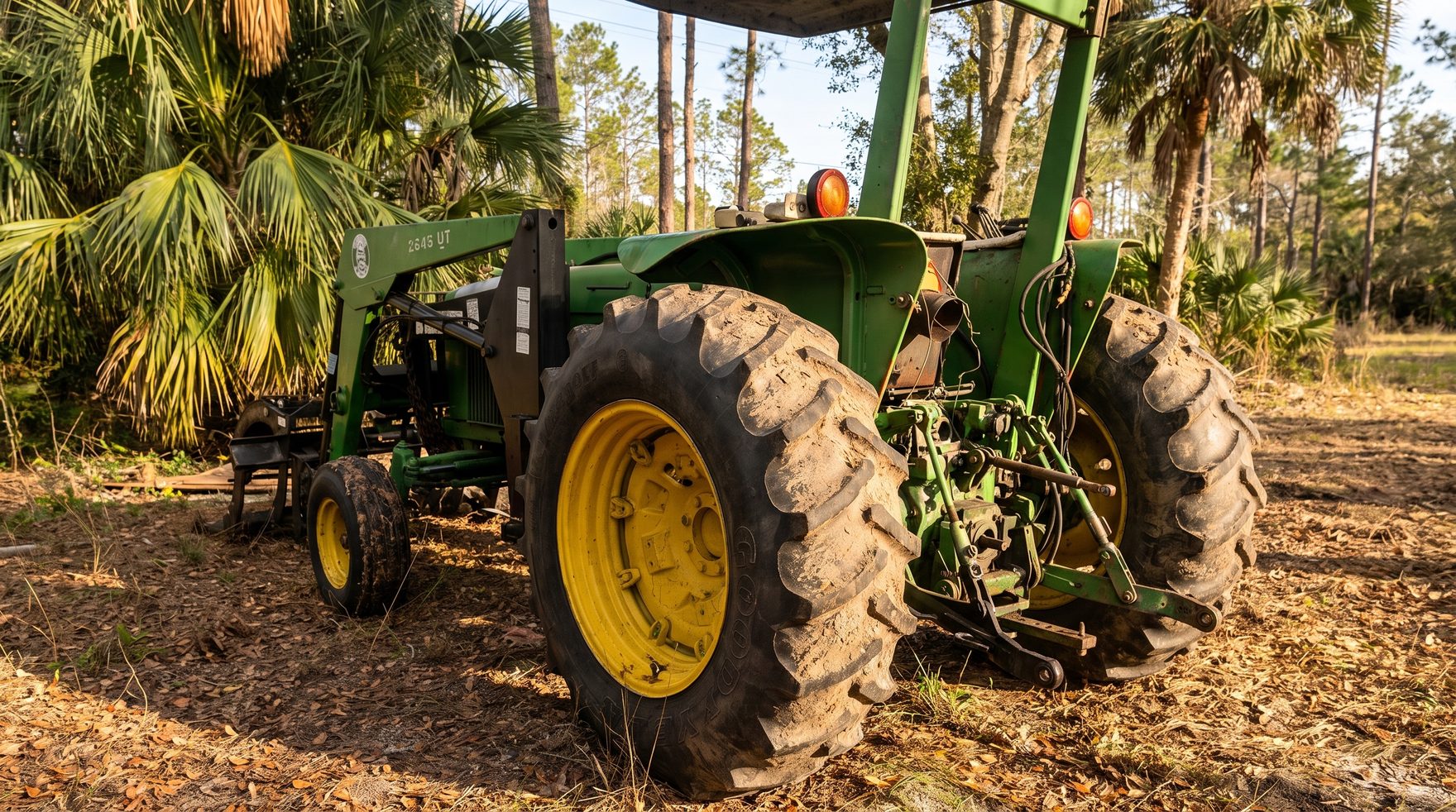
You hook up the bushhog, climb up, pull the lever, and nothing. Or worse, it lifts about six inches, grunts like it's thinking about it, and gives up. Now you're standing in the field with an implement dragging in the dirt and a to-do list that just got a lot longer. Your brain starts doing the math on a new pump, a hydraulic shop, towing the tractor somewhere, and burning half a day you didn't have. Before you go there, take a breath. A hitch that won't lift is one of the most common calls we get, and nine times out of ten it's not the disaster you're picturing. It's a hydraulic system trying to tell you something specific. You just have to know how to listen instead of guessing and throwing parts at it.
It's Hydraulics, Not Witchcraft
The 3-point hitch runs off the tractor's hydraulic system, same pump and fluid that runs your loader if you've got one, same fluid that lubricates half the drivetrain on some models. When the hitch won't lift, it's not a separate mystery part failing on its own. It's the hydraulic system somewhere upstream not doing its job, whether that's the fluid itself, the filter it's trying to get pushed through, the pump doing the pushing, or a valve deciding where the pressure goes.
That's actually good news. It means the problem is traceable. You don't need to replace the whole hitch assembly or guess your way through parts you found online. You work backward from the lift arms to the cylinders to the valve to the pump to the tank, and somewhere in that chain is your answer.
The Usual Suspects
Here's what actually causes a hitch to quit lifting, ranked roughly by how often we find it.
Low or dirty hydraulic fluid. if the fluid level is down or it's been years since a change, the pump can't build the pressure it needs, and dirty fluid accelerates wear on everything downstream.
A plugged filter or suction screen. this starves the pump of fluid before it can even do its job. Common on tractors that sit a lot or haven't seen fluid service in a long time.
A worn hydraulic pump. pumps lose their edge with age and hours. A tired pump might build enough pressure to lift an empty hitch but not enough to lift a loaded implement.
A stuck or misadjusted position or draft-control lever. these controls tell the valve what to do. If linkage is bent, worn, or out of adjustment, the valve never gets the signal to lift.
Worn lift-cylinder o-rings. internal leakage past worn seals lets fluid bypass instead of pushing the cylinder, so you get weak or no lift even with good pressure at the pump.
A stuck relief valve. if the relief valve is stuck open or set wrong, it dumps pressure before the hitch ever gets it, mimicking a bad pump.
What You Can Check Before Calling Anyone
Before you assume the worst, there's a handful of things worth five minutes and zero tools beyond a rag and a flashlight. This is the cheap stuff, and it's the first thing we check anyway, so you might as well save yourself the trip.
- Check the fluid level. with the tractor on level ground and the hitch down, check the dipstick or sight glass against the manual's spec. Low fluid is the number one cause we see.
- Look at the fluid color and smell. milky, dark, or burnt-smelling fluid means it's overdue and may already be doing damage to the pump.
- Check when the filter was last changed. if you don't know, that's your answer. A plugged filter starves the whole system.
- Test the lever through its full range. make sure the position control and draft control levers move freely and aren't binding, bent, or stuck at one end.
- Try lifting with no implement attached. if it lifts fine empty but struggles or sags loaded, that's a specific clue, not a random symptom.
Lifts Empty But Dies Under Load? That's Your Clue
This is the detail that separates a quick fix from a bigger repair, so pay attention to it. If the hitch raises fine with nothing hooked to it but won't lift, or lifts slow and sags, once you've got a disc harrow or a loaded bucket on it, that's not a fluid problem anymore. That pattern points straight at a weak hydraulic pump that can't maintain pressure under demand, or a relief valve that's letting go too early under load.
That distinction matters because pumps and relief valves aren't interchangeable guesses. One's a rebuild or replace job, the other's an adjustment or valve repair. Guessing wrong means paying for a pump you didn't need or missing a valve issue that keeps coming back.
"A hitch that lifts empty but quits under load isn't being moody. It's telling you exactly where to look."
How We Actually Diagnose It
This is where the guessing stops. We hook up gauges and pressure-test the system to see what the pump is actually building versus what it should be building at spec, and we check where pressure drops off under load. That tells us definitively whether we're looking at a pump problem, a relief valve problem, or something further down the line like worn cylinder seals.
If your tractor's hydraulics are also feeling weak or slow on other functions, like a loader or remotes, that's usually the same root cause showing up in more than one place, and it's worth reading up on why hydraulics get weak and slow under load so you know what you're dealing with before a tech shows up.
We do all of this on-site with the tractor parked right where it died. No flatbed, no dealer waiting list, no dropping the tractor off and hoping for a callback next week.
Questions
3-point hitch, quick answers
What's the most common reason a 3-point hitch won't lift?
Low, dirty, or overdue hydraulic fluid is the most common cause, followed closely by a plugged filter or suction screen starving the pump. Both are worth checking first since they're the cheapest and fastest to fix.
My hitch lifts fine empty but won't lift a loaded implement. What does that mean?
That pattern points to a weak hydraulic pump losing pressure under demand, or a relief valve releasing pressure too early. A pressure test can confirm which one it's before any parts are replaced.
Can I just add fluid and see if that fixes it?
Checking and topping off fluid is a reasonable first step and often the actual fix. But if fluid is low, also check for leaks and consider when the filter was last changed, since a low level can be a symptom of a bigger issue.
Written by
Tyler Reed, Reed's Mobile Services
Tyler is a mobile heavy equipment mechanic and welder based in Middleburg, Florida, with 12 years turning wrenches on excavators, loaders, dozers, and tractors. He fixes machines where they sit, across North Florida and South Georgia. Got one down? Call or text (352) 507-3088.